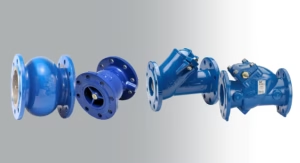
A check valve is a one-way valve that allows fluid (liquid or gas) to flow in only one direction and automatically prevents backflow. Also known as a non-return valve or one-way valve, it operates automatically without any external control—opening when flow moves in the correct direction and closing instantly when flow reverses.
Check valves are essential components in plumbing, industrial systems, pumps, and countless other applications where backflow prevention is critical. In this comprehensive guide, we’ll cover everything you need to know about check valves, including their purpose, how they work, common types, and where they’re used.

What Is the Purpose of a Check Valve?
The primary purpose of a check valve is to prevent reverse flow (backflow) in a piping system. This simple function serves several critical purposes:
| Purpose | Why It Matters |
|---|---|
| Prevent backflow | Stops contaminated water from flowing back into clean supply lines |
| Protect equipment | Prevents damage to pumps, compressors, and other machinery from reverse flow |
| Maintain pressure | Keeps system pressure stable by preventing fluid from draining back |
| Prevent water hammer | Reduces damaging pressure surges when flow suddenly stops |
| Ensure safety | Protects against cross-contamination in potable water systems |
Without check valves, water could flow backward through your plumbing, pumps could be damaged by reverse rotation, and hazardous fluids could contaminate clean systems.
How Does a Check Valve Work?
Check valves operate on a simple principle: differential pressure.
- When flow is forward: The pressure of the fluid pushes the valve’s internal mechanism (disc, ball, or flap) open, allowing flow to pass through.
- When flow stops or reverses: The mechanism automatically closes due to gravity, spring force, or reverse pressure—creating a seal that blocks backflow.
The beauty of check valves is that they require no manual operation or external power. They respond automatically to changes in flow direction, making them reliable and low-maintenance.
Check Valve Diagram
A basic check valve consists of these components:
Flow Direction →

    ┌─────────────────────┐
    │  ←── Disc/Flap ──→  │
────┤                     ├────
    │    ↑ Spring (optional)   │
    └─────────────────────┘

    Inlet                 Outlet
When pressure at the inlet exceeds the outlet, the disc opens. When outlet pressure exceeds inlet pressure, the disc seals shut.
Check Valve Symbol
Understanding the check valve symbol is essential for reading piping and instrumentation diagrams (P&IDs).
Standard Check Valve Symbols
One-Way Valve Symbol / Non-Return Valve Symbol:

    ──────▷|──────      (Standard check valve)

    ──────▷◯──────      (Ball check valve)

    ──────▷|←──────     (Spring-loaded check valve)
The triangle (▷) indicates flow direction—fluid can only flow in the direction the triangle points. The vertical line (|) represents the closing mechanism that blocks reverse flow.
Key symbol variations:
- Standard symbol: Triangle with vertical line
- Ball check: Triangle with circle
- Spring-loaded: Triangle with spring indicator
When reading valve symbols on diagrams, always note that flow moves from the open side of the triangle toward the blocked side.
Types of Check Valves
Different applications require different types of check valves. Here are the most common:
1. Swing Check Valve

- How it works: A hinged disc swings open with forward flow and swings shut when flow reverses
- Best for: Low-velocity, steady flow applications
- Common uses: Water supply lines, wastewater systems
- Pros: Low pressure drop, simple design
- Cons: Not suitable for pulsating flow
2. Spring-Loaded Check Valve (Spring Check Valve)

- How it works: A spring holds the disc closed; flow must overcome spring pressure to open
- Best for: Systems requiring fast closure and vertical installations
- Common uses: Pumping systems, high-pressure lines
- Pros: Works in any orientation, fast response
- Cons: Higher pressure drop than swing type
3. Ball Check Valve

- How it works: A ball seals against a seat; forward flow pushes the ball aside
- Best for: Viscous fluids, slurries, and sanitary applications
- Common uses: Chemical processing, food industry
- Pros: Reliable sealing, handles solids well
- Cons: Slower response time
4. Lift Check Valve

- How it works: A disc or piston lifts off its seat with forward flow
- Best for: High-pressure applications
- Common uses: Steam systems, boiler feedwater
- Pros: Tight sealing, durable
- Cons: Must be installed horizontally
5. Dual Plate (Butterfly/Wafer) Check Valve

- How it works: Two half-circle plates fold open with flow
- Best for: Large diameter pipes where space is limited
- Common uses: Industrial pipelines, HVAC systems
- Pros: Compact, lightweight, low pressure drop
- Cons: More complex design
6. Diaphragm Check Valve

- How it works: A flexible diaphragm opens and closes with flow changes
- Best for: Low-pressure applications, corrosive fluids
- Common uses: Medical equipment, chemical handling
- Pros: Self-cleaning, excellent for slurries
- Cons: Limited pressure range
Check Valve Types Comparison Table
| Type | Pressure Drop | Response Speed | Installation | Best Application |
|---|---|---|---|---|
| Swing | Low | Slow | Horizontal | General water systems |
| Spring-loaded | Medium | Fast | Any orientation | Pump discharge |
| Ball | Medium | Medium | Vertical preferred | Viscous fluids |
| Lift | Medium-High | Fast | Horizontal | High-pressure steam |
| Dual Plate | Very Low | Very Fast | Any orientation | Large industrial pipes |
| Diaphragm | Low | Medium | Any orientation | Corrosive/sanitary |
What Is a Check Valve Used For?
Check valves serve critical functions across many industries. Here are the most common applications:
Check Valve in Plumbing
What is a check valve in plumbing? In residential and commercial plumbing, check valves prevent contaminated water from flowing back into the clean water supply. Common uses include:
- Water heater lines: Prevents hot water from backing into cold supply
- Sump pump discharge: Stops water from draining back into the sump pit
- Irrigation systems: Prevents soil and pesticides from contaminating water supply
- Backflow prevention assemblies: Required by code in many jurisdictions
Check Valve for Water Pump
A check valve for water pump applications is essential because:
- Prevents pump damage from reverse rotation
- Maintains prime in the pump (keeps water in the line)
- Reduces energy waste from re-pumping drained water
- Prevents water hammer when pump shuts off
Installation tip: Always install check valves on the discharge side of pumps, positioned to allow easy maintenance access.
Industrial Applications
- Oil and gas pipelines: Prevents backflow in multi-pump systems
- Chemical processing: Isolates process streams and prevents contamination
- Power generation: Protects boilers and steam systems
- HVAC systems: Maintains proper flow in chilled water loops
Other Common Uses
- Compressed air systems
- Fuel lines in vehicles and aircraft
- Medical equipment (IV lines, ventilators)
- Aquariums (air pump lines)
- Pool and spa systems
Check Valve vs Gate Valve: What’s the Difference?
People often confuse check valves with gate valves. Here’s how they differ:
| Feature | Check Valve | Gate Valve |
|---|---|---|
| Primary function | Prevent backflow automatically | Control/isolate flow manually |
| Operation | Automatic (no handle) | Manual (handwheel or actuator) |
| Flow direction | One-way only | Bidirectional |
| Position | Open or closed only | Can be partially open |
What is a gate valve? A gate valve is a manually operated valve used to start or stop flow—not to regulate it. It uses a sliding gate mechanism to block the pipe. Gate valve purpose is primarily isolation, allowing sections of a system to be shut down for maintenance.
Key difference: Check valves work automatically to prevent backflow; gate valves are manually operated to completely stop flow when needed.
How to Select the Right Check Valve
Choosing the correct check valve depends on several factors:
1. Application Requirements
- What fluid will flow through it? (Water, oil, gas, chemicals)
- What is the flow rate and pressure?
- Is backflow prevention critical for safety?
2. Installation Considerations
- Horizontal or vertical pipe orientation?
- Space constraints?
- Accessibility for maintenance?
3. Performance Factors
- Acceptable pressure drop?
- Required response time?
- Expected frequency of operation?
4. Material Compatibility
- Is the fluid corrosive?
- What temperature range?
- Food-grade or sanitary requirements?
Quick Selection Guide
| If You Need… | Choose This Type |
|---|---|
| General water systems, low cost | Swing check valve |
| Fast closure, pump protection | Spring-loaded check valve |
| Handling slurries or viscous fluids | Ball check valve |
| High-pressure steam or gas | Lift check valve |
| Large pipes, minimal pressure drop | Dual plate check valve |
| Corrosive or sanitary applications | Diaphragm check valve |
Check Valve Installation Best Practices
Proper installation ensures reliable performance:
- Verify flow direction: Arrow on valve body must match intended flow direction
- Choose correct orientation: Some types only work horizontally
- Size appropriately: Undersized valves cause excessive pressure drop; oversized valves may not seal properly
- Allow access: Install where maintenance and inspection are possible
- Consider strainers: Install upstream strainers to prevent debris from damaging the valve
- Support piping: Prevent stress on valve connections from unsupported pipes
Common Check Valve Problems and Solutions
| Problem | Cause | Solution |
|---|---|---|
| Valve won’t open | Debris blocking disc, spring too strong | Clean valve, check spring rating |
| Valve won’t close | Worn seat, debris preventing seal | Replace seat, clean valve |
| Water hammer | Valve closing too slowly | Use spring-loaded or faster-acting type |
| Excessive noise | Disc flutter from turbulent flow | Resize valve, add flow straighteners |
| Leaking | Damaged seal, corrosion | Replace seals or entire valve |
Conclusion
A check valve is a simple yet essential component that automatically prevents backflow in any piping system. Whether you’re protecting a water pump, maintaining plumbing system integrity, or preventing contamination in industrial processes, the right check valve ensures reliable one-way flow without manual intervention.
Key takeaways:
- Check valves allow flow in one direction only and close automatically when flow reverses
- Different types (swing, spring-loaded, ball, lift, dual plate, diaphragm) suit different applications
- The standard check valve symbol shows a triangle pointing in the flow direction
- Proper selection depends on fluid type, pressure, flow rate, and installation requirements
Understanding check valve types, symbols, and applications helps you select the right valve for any system—ensuring safety, efficiency, and equipment protection.
Need help selecting the right check valve for your application? Contact our technical team for expert guidance on valve selection and sizing.