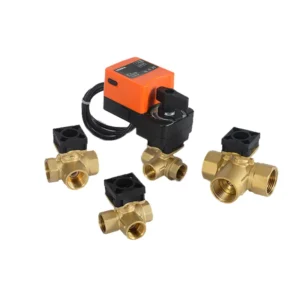
Brass 3 way valve in chilled water system
This product is a Brass 3-Way Valve specifically designed for use in Hydronic Heating, Ventilation, and Air Conditioning (HVAC) systems, particularly for controlling the flow of chilled water or hot water to terminal units (like coils or fan coil units). Its function is to modulate or divert the flow to maintain a set temperature or flow rate in the system.
📋 Technical Specifications
| Parameter | Detail / Rating |
| Valve Type | 3-Way Ball Valve |
| Media | Cold/Hot Water, up to 50% Glycol solution |
| Medium Temperature | 2°C to 90°C |
| Rated Pressure | PN20 (≈ 20 bar) |
| Body Material | Forged Brass (Hpb59-1) |
| Connection | Internal Thread (Pipe Connector) |
| Ambient Temperature | -5°C to +60°C (0-90%RH) |
| Nominal Size | 15mm (1/2”) |
| Flow Coefficient (K_vs) | 6.3m³/h |
⭐ Material and Performance Details
| Component | Material | Notes |
| Valve Body | Forged Brass (Hpb59-1) | Provides high strength and excellent corrosion resistance for water and glycol solutions. |
| Ball | Stainless Steel / Brass | Ensures durability and low friction during rotation. |
| Seals | EPDM + PTFE | EPDM is ideal for water/glycol applications and flexibility; PTFE provides robust chemical and temperature resistance. |
| Rated K_vs | 6.3m³/h | This indicates the flow rate of water through the fully open valve (in m³/h) that results in a pressure drop of 1 bar. |
| Maximum Operating Pressure (Pv_max) | 2.5MPa (≈ 25ba) | The maximum pressure differential the actuator can close against. |
| Shut-Off Pressure (Ps) | 1400KPa (≈ 14bar) | The maximum pressure the valve can seal against when fully closed. |
💡 Function in a Chilled Water System
In a chilled water system, a 3-way valve is used for two main purposes:
Mixing Valve (Primary Use): Blends the cool supply water with the warmer return water from the coil to modulate the temperature supplied to the air handling unit.
Diverting Valve: Diverts the return water back to the chiller or to a bypass loop.
By controlling the proportion of water flowing through the coil versus bypassing it, the valve maintains the desired cooling capacity and prevents unnecessary low-flow conditions for the chiller.
The 2°C minimum medium temperature confirms its suitability for HVAC chilled water applications, where supply temperatures are typically between 4°C and 7°C.
Fast Response & Competitive Pricing Start Here
* We are not just providing simple quotes but experts in selection, calculation, and drawing.