
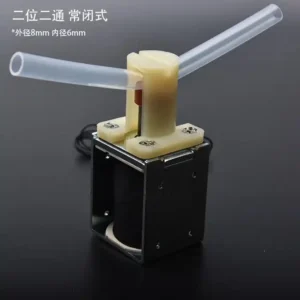
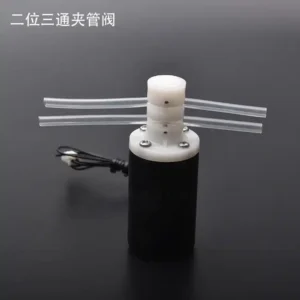
Solenoid Tube Pinch Valve (Silicone Tubing, Customizable)
The Solenoid Tube Pinch Valve, also known as a squeeze valve or pinch valve, is a crucial component for precise, contaminant-free fluid control, particularly in chemical and biomedical fields. Its fundamental design ensures that the working fluid only contacts the easily replaceable soft tubing, completely isolating the medium from the metallic or plastic valve body parts.
📋 Technical Specifications and Customization
| Parameter | Detail / Option |
| Product Name | Solenoid Tube Pinch Valve |
| Body Material | Plastic, Aluminum |
| Tubing Material | Silicone Tube, Biochemical Tube, etc. |
| Tube Outer Diameter (OD) | 3, 5, 8, 9.5mm, etc. |
| Tube Inner Diameter (ID) | 1, 3, 6, 7mm, etc. |
| Customization | Available (Non-standard sizes and structures can be customized) |
⭐ Solenoid Pinch Valve Principle
The valve utilizes an electromagnetic mechanism to achieve flow control:
Actuation: An electromagnet pulls a core/plunger, which in turn drives a piston or jaw mechanism within the valve body.
Control: This piston either squeezes or releases the flexible soft tube (silicone tube) inside the valve to control the ON (open) or OFF (closed) state of the fluid path.
Isolation: Since the liquid passes only through the tubing, the valve parts never contact the fluid. This is highly advantageous for:
Handling Particulate Media: Prevents clogging often seen in traditional solenoid valves.
Preventing Contamination: Guarantees the liquid remains pure and is not contaminated by valve materials.
Maintenance: The soft tubing is a wearable component. When the tubing reaches its service limit, it can be easily and quickly replaced, refreshing the valve’s functionality.
💡 Valve Structures Available
The pinch valve can be configured for various flow controls:
2-Way, Normally Closed (NC): Single tube; Energized → Open, De-energized → Closed.
2-Way, Normally Open (NO): Single tube; Energized → Closed, De-energized → Open.
3-Way: Dual tubes; One path NC, one path NO. Energizing reverses the states (NC → Open, NO → Closed).
🧪 Tubing Material and Installation
Silicone Tube: Highly popular due to its very smooth inner wall and superior memory retention. The smooth wall is critical for minimizing residual fluid, and the memory retention helps prevent the tube from sticking closed after prolonged OFF states.
Biochemical Tube: Designed specifically for resistance to acids, alkalis, and solvents. (Note: Use caution or select specialized tubes for oily or organic solvents).
Installation: The tubing must be correctly seated within the valve body’s installation slot, which features a smooth, circular arc structure. The groove is designed with a slight gap less than the tube’s outer diameter to ensure the tube is fixed tightly but maintains its cross-sectional area when fully open.
🏭 Application and Market Outlook
This type of valve is widely used in high-precision and contamination-sensitive sectors:
Chemical Analysis and Dosing
Environmental Monitoring (Water Quality, Waste Fluid Discharge)
Biochemistry and Life Sciences
Medical Diagnostic Equipment
Fast Response & Competitive Pricing Start Here
* We are not just providing simple quotes but experts in selection, calculation, and drawing.


