When selecting control valves, you’ll often see two flow coefficients: Kv and Cv.
They both describe how much flow a valve can pass — but they use different units and standards.
The main difference between Cv and Kv values for valves is the unit system: Cv (Imperial) measures flow in US Gallons per Minute (GPM) with a 1 psi pressure drop, used mainly in North America, while Kv (Metric) measures flow in Cubic Meters per Hour (m³/h) with a 1 bar pressure drop, common in Europe and globally. Both quantify a valve’s flow capacity, but using different scales; the relationship is roughly Cv ≈ 1.156 * Kv.
Here’s the full breakdown.
Table of Contents
ToggleQuick Answer
Cv = U.S. flow coefficient (gallons per minute, psi)
Kv = European/metric flow coefficient (m³/h, bar)
Both represent the same physical concept: how easily a valve allows fluid to pass at a given pressure drop.
What Is Cv (Flow Coefficient)?
Cv = the number of U.S. gallons per minute (GPM) of water at 60°F that flows through a valve with a 1 psi pressure drop.
Formula (US system)
Q=CvΔP/SGQ = C_v \sqrt{\Delta P / SG}Q=CvΔP/SG
Where:
Q = flow rate (GPM)
Cv = valve flow coefficient
ΔP = pressure drop (psi)
SG = specific gravity of fluid (water = 1)
Used in:
USA
Oil & gas
HVAC
Industrial piping
Manufacturers like Apollo, Nibco, Watts, etc.
What Is Kv (Metric Flow Coefficient)?
Kv = the number of cubic meters per hour (m³/h) of water at 20°C that flows through a valve with a 1 bar pressure drop.
Formula (metric system)
Q=KvΔP/SGQ = K_v \sqrt{\Delta P / SG}Q=KvΔP/SG
Where:
Q = flow rate (m³/h)
ΔP = pressure drop (bar)
Used in:
Europe
Asia
ISO/EN standards
Pneumatic and industrial valves
Brands like Danfoss, Bürkert, Samson, etc.
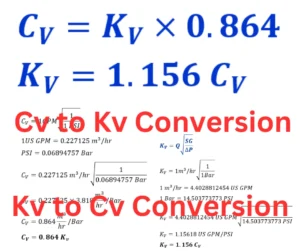
Conversion Between Cv and Kv
Because they describe the same physical property, you can convert between them easily.
Cv to Kv
Kv=0.865×CvK_v = 0.865 \times C_vKv=0.865×Cv
Kv to Cv
Cv=1.156×KvC_v = 1.156 \times K_vCv=1.156×Kv
Key Differences (Table)
| Feature | Cv | Kv |
|---|---|---|
| Unit System | U.S. customary | Metric (SI) |
| Flow Unit | GPM (water @ 60°F) | m³/h (water @ 20°C) |
| Pressure Drop | psi | bar |
| Standard | ANSI / ISA | ISO / EN |
| Common Regions | USA, Canada | Europe, Asia |
| Industries | Plumbing, HVAC, industrial | Process control, industrial automation |
| Conversion | Cv × 0.865 = Kv | Kv × 1.156 = Cv |
Which One Should You Use?
Use Cv when:
You work in North America
Specs are in PSI and GPM
Using ANSI/ASME valves
Use Kv when:
You work in Europe or Asia
Specs are in bar and m³/h
You follow ISO or EN standards
For global projects:
Manufacturers usually provide both Cv and Kv ratings.
Example for Clarity
A valve has:
Cv = 10
Convert to Kv:
Kv=0.865×10=8.65K_v = 0.865 \times 10 = 8.65Kv=0.865×10=8.65
Or if you have:
Kv = 12
Convert to Cv:
Cv=1.156×12=13.87C_v = 1.156 \times 12 = 13.87Cv=1.156×12=13.87
Why Cv and Kv Matter
Choosing the correct valve depends on the required flow rate. A valve with:
too low Cv/Kv → insufficient flow
too high Cv/Kv → poor control resolution
Proper calculation ensures:
stable flow
accurate control
minimized pressure loss
energy efficiency
Summary
Cv and Kv measure the same thing: valve flow capacity.
Difference = unit system (U.S. vs metric).
Conversion is simple:
Cv = Kv × 1.156
Kv = Cv × 0.865
Use the coefficient appropriate for your region, industry, or specification standard.