While the piercing saddle valve is often praised for its “instant” installation, many professional plumbers and mechanical engineers consider it a liability. In fact, in many jurisdictions, the use of piercing-style valves is now restricted or banned by Plumbing Codes for permanent installations.
If you are looking to replace a saddle valve with something better, or if you are designing a high-pressure system for a 2” line or larger, it is time to look at professional-grade alternatives that offer superior flow, longevity, and safety.
1. Why Experts Avoid Piercing Saddle Valves
Before selecting an alternative, it’s important to understand why the industry is moving away from saddle valves:
Restricted Flow: The tiny hole created by a piercing needle significantly limits GPM (Gallons Per Minute).
High Failure Rate: The small orifice is prone to clogging with mineral scale and sediment.
Code Compliance: Many international and local building codes no longer recognize piercing valves as a “permanent” connection due to their reliance on a single external rubber gasket.
2. Top Professional Alternatives for Copper & PEX
If you want a “set it and forget it” connection for your ice maker, filter, or branch line, consider these saddle valve alternatives:
A. The Add-A-Tee Valve (The Pro’s Choice)

Instead of piercing the pipe, an Add-A-Tee (or Stop Valve Tee Adapter) screws directly onto your existing shut-off valve. It provides a dedicated 1/4” or 3/8” outlet without any cutting or piercing of the main line.
B. Push-to-Connect Tees
For mid-pipe connections, Push-fit Tees (such as SharkBite or similar) allow you to cut the pipe and “push” a permanent tee fitting into place. No soldering is required, and the connection is rated for 25 years or more.
C. PEX Manifolds
In modern construction, tapping into a central PEX Manifold is the gold standard. This allows for individual isolation of every water line in the building, eliminating the need for localized saddle valves entirely.
3. Industrial Solutions: PVC Saddle Tees and Large Pipes
When working with PVC pipes or lines larger than 1”, the standard “needle” valve is physically incapable of doing the job.
PVC Saddle Tee (Mechanical): For a saddle valve for 2 inch pipe or larger, engineers use a Mechanical Saddle Tee. These utilize a full-circumference clamp and a solvent-weld or heavy-duty O-ring seal, providing the strength needed for irrigation or industrial processing.
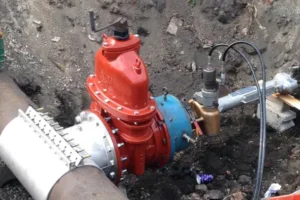
Tapping Sleeves: For municipal-grade PVC or Ductile Iron, a Tapping Sleeve and Valve (TS&V) assembly is the only professional way to add a branch while the line is under pressure.
4. Comparison: Saddle Valve vs. Standard Tee Fitting
| Feature | Piercing Saddle Valve | Professional Tee Fitting |
| Connection Method | Piercing Needle | Mechanical Joint/Solvent Weld |
| Expected Lifespan | 2–5 Years (High risk) | 20–50 Years (Low risk) |
| Flow Capacity | Very Low (Restricted) | Full Bore (Unrestricted) |
| Leak Resistance | Moderate to Poor | Excellent (Code Compliant) |
| Best For | Temporary/Emergency | Permanent Infrastructure |
5. Upgrade Your System Today
Don’t wait for a slow leak to turn into a costly repair. Whether you are a homeowner upgrading a kitchen or a contractor managing a commercial PVC line, choosing a saddle valve alternative ensures your plumbing remains robust and compliant.