If you are operating in the food, beverage, or pharmaceutical industries, you already know that “Sanitary” is more than just a label—it’s a commitment to consumer safety. You buy Stainless Steel 316L valves, you run regular CIP (Clean-in-Place) cycles, and you expect your line to be sterile.
But here is a dirty secret: Standard sanitary ball valves have a hidden “dead zone” that your cleaning chemicals can’t reach. Every time you cycle a standard ball valve, a small amount of product gets trapped in the body cavity. Over time, this trapped residue becomes a breeding ground for bacteria, leading to cross-contamination and potential batch recalls. The solution? The Cavity-Filled Ball Valve.
1. The Anatomy of a Contamination: The “Standard” Problem
To understand the value of a cavity-filled design, we must look at the flaw in a standard ball valve.
The Cavity: In a typical ball valve, there is an empty space between the ball and the valve body.
The Entrapment: When the valve is opened or closed, the liquid inside the ball “spills” into this internal cavity.
The “Dead Zone”: Because this area is isolated from the main flow path, your CIP fluids cannot flush it out. If you are processing milk, sugar-rich juices, or biological agents, these trapped particles will rot inside your valve.
2. What is a Cavity-Filled Ball Valve?
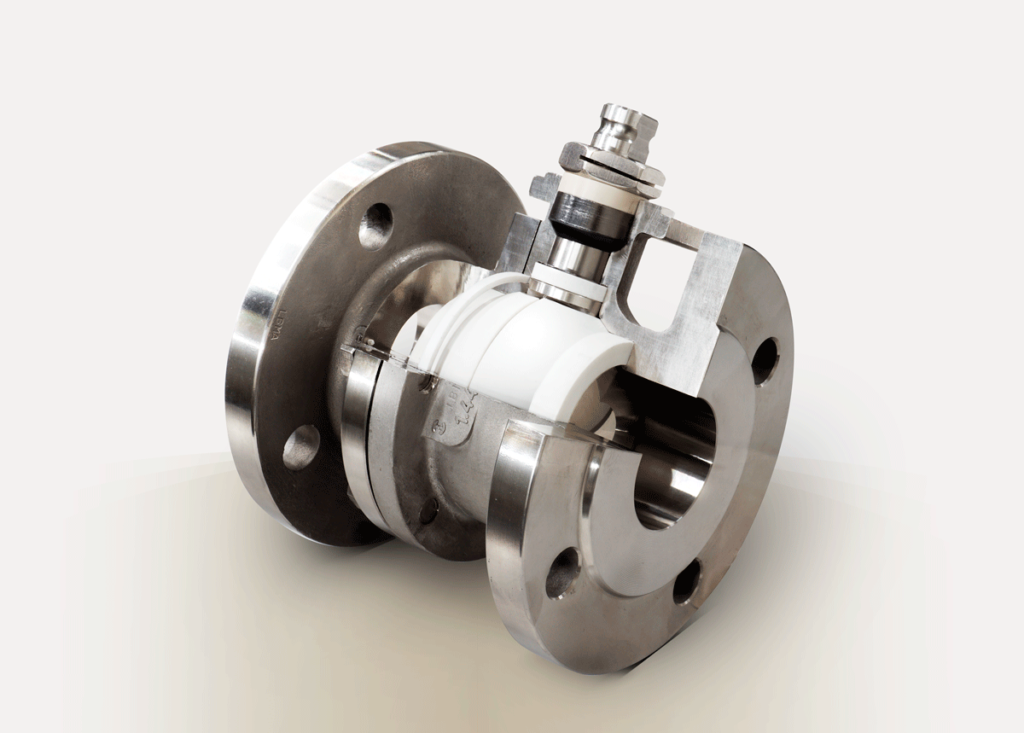
A Cavity-Filled Ball Valve (also known as an Encapsulated Seat valve) is engineered specifically to eliminate this “dead zone.”
The Design: Instead of standard ring-shaped seats, we use expanded PTFE seats that wrap around the entire ball, filling 99% of the internal body void.
The Action: Since there is no empty space (cavity), there is nowhere for the product to hide. Every drop of liquid stays in the flow path.
The Result: Total displacement. When you flush the line, you are flushing the entire valve.
[Image Suggestion: Side-by-side comparison diagram showing “Standard Seat” with red area for trapped fluid vs. “Cavity Filled Seat” with zero gaps]
3. The Economics of “Safety First”
Many procurement managers hesitate because Cavity-Filled valves cost approximately 20-30% more than standard sanitary valves. However, let’s look at the Total Cost of Ownership (TCO):
Reduced Recall Risk: A single contaminated batch can cost $50,000 to $1,000,000. Investing an extra $100 in a better valve is the cheapest insurance policy you will ever buy.
Faster CIP Cycles: Because there is no hidden residue, your cleaning cycles are more effective and can be completed faster, saving water and chemical costs.
Longer Seal Life: The encapsulated seat design provides better support for the ball, often resulting in fewer leaks and longer maintenance intervals.
4. When is a Cavity-Filled Valve MANDATORY?
If your process involves any of the following, do not settle for a standard ball valve:
Dairy & Egg Processing: Highly prone to rapid spoilage.
Chocolate & Nut Butters: High-viscosity products that are impossible to flush out of cavities.
Pharmaceuticals & Vaccines: Where “Zero Bacteria” is the legal requirement.
Cosmetics & Creams: Where cross-contamination of scents or active ingredients destroys product quality.
5. Comparison: Standard vs. Cavity Filled
| Feature | Standard Sanitary Ball Valve | Cavity-Filled Ball Valve |
| Internal Void | Large (Traps product) | Minimized (99% Filled) |
| Cleaning | Difficult to reach internals | Excellent for CIP/SIP |
| Bacteria Risk | Moderate to High | Very Low |
| Best For | Water, Air, Simple utilities | Food, Pharma, Viscous Media |
Conclusion: Don’t Compromise on Hygiene
“Sanitary” should mean “Sterile.” If your valve design allows for product entrapment, you are taking a risk with every batch you produce. By upgrading to Cavity-Filled Ball Valves, you eliminate the hidden traps and ensure that your process is as clean on the inside as it looks on the outside.