A swing check valve is a type of non-return valve (or one-way valve) that allows fluid to flow freely in one direction while automatically preventing reverse flow.
It operates using a disc (clapper) that swings open under forward flow pressure and closes when the flow stops or reverses.
Due to its simple structure, low pressure drop, and reliable sealing, the swing check valve is widely used in water treatment, oil and gas, chemical processing, HVAC, and power generation systems.
However, not all swing check valves are the same. They come in several types, each designed for specific working conditions and applications.
This article explains the main types of swing check valves, their designs, functions, and typical uses.
1. Standard Swing Check Valve

Overview
The standard swing check valve is the most common type.
It features a single disc attached to a hinge pin inside the valve body. The disc swings freely to open or close depending on the flow direction.
Key Features
Simple, robust structure
Suitable for horizontal or slightly inclined pipelines
Available in materials like cast iron, carbon steel, stainless steel, and bronze
Applications
Water supply and drainage systems
Oil and gas pipelines
General industrial services
2. Dual Plate (Double Door) Swing Check Valve
Overview
Also known as a dual disc check valve, this design uses two spring-loaded plates instead of a single swinging disc.
The plates open under forward flow and close quickly under reverse flow, reducing the risk of water hammer.
Key Features
Compact and lightweight design
Fast closing response
Lower pressure loss than traditional swing check valves
Suitable for both horizontal and vertical installations
Applications
HVAC and fire protection systems
Marine and shipbuilding
Power plant cooling water lines
Pump discharge lines
3. Tilting Disc Swing Check Valve
Overview
The tilting disc check valve improves upon the standard design by tilting the disc slightly instead of allowing it to swing freely.
This reduces the stroke length, enabling faster closure and minimizing water hammer.
Key Features
Smooth and quiet operation
Reduced water hammer risk
Works well in both horizontal and vertical flow-up applications
Can handle large flow rates efficiently
Applications
Water and wastewater treatment
Power generation cooling systems
Industrial fluid transport
4. Wafer Type Swing Check Valve
Overview
The wafer type swing check valve is designed for space-saving installation between two flanges.
It has a thin, compact body that fits in tight piping layouts.
Key Features
Lightweight and easy to install
Lower material and installation cost
Ideal for systems with limited space
Often made from stainless steel or ductile iron
Applications
Chemical processing systems
HVAC and building services
Compact piping networks
Seawater and desalination plants
5. Full Body (Flanged) Swing Check Valve
Overview
The flanged swing check valve has a full-body design with standard flanged ends, allowing easy installation and maintenance.
It provides a tight seal and is ideal for heavy-duty applications.
Key Features
Full-size body for better durability
Easy access for inspection and repair
Can handle high flow rates and pressures
Available in ANSI and DIN flange standards
Applications
Oil and gas pipelines
Power plants
Industrial water and steam systems
6. Spring-Assisted Swing Check Valve
Overview
In this design, a spring mechanism helps close the disc more quickly when the flow reverses.
This prevents slamming and water hammer, especially in high-speed fluid systems.
Key Features
Fast and controlled closure
Prevents valve chatter and vibration
Ideal for pulsating or variable flow systems
Works in both horizontal and vertical positions
Applications
High-pressure fluid lines
Pump discharge systems
Steam and condensate lines
Process control systems
7. Silent Swing Check Valve
Overview
The silent check valve (a variation of the spring-assisted type) uses a spring-loaded disc that closes gradually and silently when flow stops.
It eliminates slamming noise and water hammer.
Key Features
No slamming or vibration
Quiet operation
Suitable for clean fluids and HVAC systems
Compact and maintenance-free
Applications
HVAC chilled water lines
Building water supply systems
Irrigation and fire protection systems
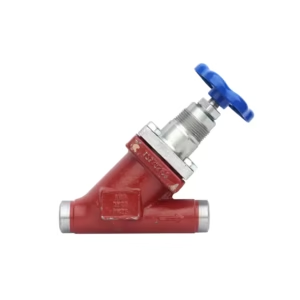
8. Y-Type Swing Check Valve
Overview
The Y-pattern swing check valve features an inclined body design (Y-shaped) that allows the disc to close more quickly with reduced impact.
It offers better drainage and lower pressure drop than standard models.
Key Features
Smooth flow path and low resistance
Easy to clean and maintain
Often used in steam and condensate systems
Applications
Steam pipelines
Condensate recovery systems
Chemical and process industries
Conclusion
Swing check valves come in a variety of designs to meet different operational needs.
From standard flanged types for heavy-duty use to wafer and silent types for compact or noise-sensitive environments, each valve serves a specific purpose.
Summary Table:
| Type | Main Feature | Typical Applications |
|---|---|---|
| Standard Swing | Simple, reliable design | Water, oil, gas systems |
| Dual Plate | Compact, anti-water hammer | HVAC, marine, power plants |
| Tilting Disc | Fast closure, quiet | Cooling, wastewater |
| Wafer Type | Slim, lightweight | Chemical, HVAC |
| Full Body | Heavy-duty, flanged | Power, oil & gas |
| Spring-Assisted | Quick closure | Pumps, high-pressure systems |
| Silent | Noise-free operation | HVAC, building services |
| Y-Type | Smooth flow path | Steam and condensate lines |
By understanding the different types of swing check valves, engineers and plant operators can choose the right design for their system — ensuring efficiency, safety, and durability.